

In search of the core values that define Judaism and the Jewish people throughout the ages.
Dear Reader,
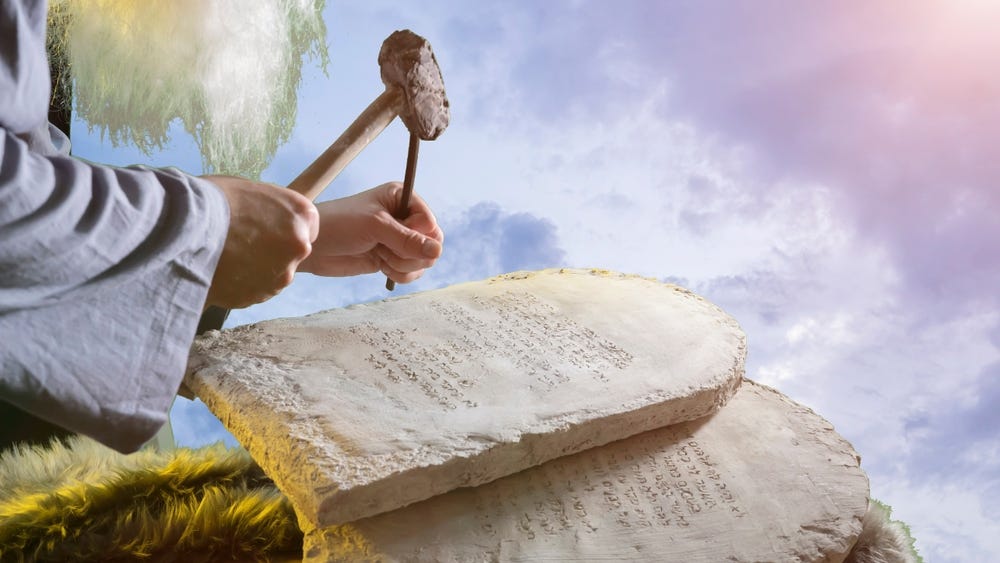
If Moses was coming down from Mt. Sinai with Ten Commandments for Jews living in 2026 rather than in biblical times, what would those commandments be?
At this holiest season of the Jewish calendar, that’s the question I posed to ChatGPT the other day, noting that for all of the differences between and among our various denominations today, there are eternal principles that we should all hold dear.
Drawing on a wide range of influential modern-day rabbis and Jewish thinkers, here is ChatGPT’s response to my question.
I very much welcome your feedback.
Gary
The Ten Commandments for a 21st-Century Jew
1. Remember that you are in covenant—with God, with the Jewish people and with humanity.
Judaism is not merely a religion of private belief. It is a relationship of obligation.
Rabbi Jonathan Sacks repeatedly described Judaism as an “ethic of responsibility”: God calls human beings to become partners in creation. David Hartman similarly argued that covenant gives Jews the responsibility to participate actively in shaping Jewish history rather than passively awaiting redemption.
The 21st-century translation:
Don’t ask only, “What do I believe?” Ask, “What am I responsible for?”
2. Honor the divine image in every human being—including the person who is not like you.
The Torah’s assertion that human beings are created in God’s image becomes, in contemporary Jewish thought, a foundation for human dignity.
Rabbi Sacks places human dignity at the very beginning of Jewish ethics. Rabbi Angela Buchdahl identifies the dignity of every person as one of Judaism’s central values. Rabbi David Hartman warned against allowing Jewish particularism to become moral blindness toward outsiders.
This doesn’t require Jews to abandon Jewish particularity. Quite the opposite: Judaism’s particular covenant is supposed to produce a universal moral consciousness.
3. Choose life—and protect it.
Pikuach nefesh (saving a life) is one of Judaism’s great organizing principles.
Human life is sacred. That means opposing murder, cruelty and the casual devaluation of human beings. But it also means recognizing the responsibilities that accompany power—including Jewish power and the power of the State of Israel.
Rabbi Sacks describes the sanctity of life as a central pillar of Jewish ethics and sees violence as something that requires extraordinary moral justification.
Choose life doesn’t mean choose safety at any price. It means never forget the value of the life you are defending—or the moral obligations that come with defending it.
4. Love your neighbor—and refuse to become indifferent to the stranger.
This may be the most recognizable commandment on the list.
But contemporary rabbis tend to expand rather than dilute it. Rabbi Sacks identifies three great loves at the center of Jewish ethics: love of God, love of neighbor and love of the stranger.
Rabbi Shai Held has made love and compassion central to his understanding of Judaism, arguing that approaching God should move us toward—not away from—the suffering of other people.
And Rabbi Buchdahl connects Jewish memory of slavery directly to the obligation to recognize the stranger.
The modern test is not whether you love humanity in the abstract. It is whether you notice the human being standing in front of you.
5. Make your Jewish life an act of responsibility, not merely an expression of identity.
This is perhaps the strongest theme running through Rabbis Sacks, Hartman and Yitz Greenberg.
Being Jewish isn’t simply something one is. It is something one does.
Rabbi Sacks argued that Judaism is fundamentally about responsibility and that Jews are called upon to be a blessing to others.
Rabbi Hartman similarly regarded covenant as something that liberates human initiative and demands active participation in Jewish history.
Rabbi Greenberg takes the idea even further in his post-Holocaust theology: Jews become partners with God in bringing redemption into the world.
Don’t merely complain about the state of the Jewish world. Take responsibility for it.
6. Honor Torah—but keep learning, questioning and arguing.
A 21st-century Judaism cannot be intellectually timid.
Rabbi Hartman famously built his theology around the idea that Torah is not simply a fixed set of answers but a covenant in which human beings participate in interpreting and applying God’s demands. The rabbinic principle of lo bashamayim hi—“it is not in heaven”—gives human beings responsibility for working out Torah’s meaning.
Rabbi Buchdahl similarly identifies inquiry and multiple opinions as essential Jewish values.
That is an old Jewish idea disguised as a modern one.
Questioning Judaism is not necessarily rebellion against Judaism. Sometimes it is the most Jewish thing you can do.
7. Build and preserve Jewish community.
The great contemporary rabbis are remarkably consistent here: the individual Jew cannot sustain Judaism alone.
Rabbi Sacks argued that the virtues necessary for a moral life are cultivated through families, communities, study, ritual, storytelling, celebration and shared memory.
This means synagogue, family, Jewish education, Shabbat, holidays, Hebrew, Jewish history and communal institutions aren’t merely nostalgic artifacts.
They are the infrastructure of Jewish continuity.
A Jew who says, “I’m spiritual but I don’t need Jewish community,” may be sincere. But he or she is making the survival of Judaism considerably more difficult.
8. Remember where you came from—and teach it to those who come after you.
Modern Jews live with a peculiar danger: unprecedented freedom combined with unprecedented historical amnesia.
The Exodus, Sinai, Jerusalem, the destruction of the Temples, exile, antisemitism, the Holocaust and the creation of Israel are not simply things Jews once studied.
They are the accumulated memory of a people.
Rabbi Hartman argued that Jewish memory of Egypt should not produce perpetual victimhood but should be transformed into a moral obligation to pursue justice and love.
So the commandment becomes:
Remember—but don’t live only in the past. Turn memory into moral action.
That is particularly important after October 7.
9. Seek justice, even when justice is inconvenient to your own side.
This is where contemporary Jewish ethics becomes genuinely demanding.
Judaism does not permit Jews to abandon universal morality when Jews themselves are involved.
Rabbi Hartman explicitly rejected the idea that Jewish solidarity requires indifference to suffering outside the Jewish community.
Rabbi Held similarly emphasizes that God’s opposition to injustice is universal, while maintaining the importance of Jewish particularity.
The commandment therefore isn’t:
“Always agree with your fellow Jews.”
It is:
“Hold your own people to the highest moral standards—and do the same for everyone else.”
That cuts in both directions, which is precisely why it’s difficult.
10. Do not merely inherit Judaism. Renew it.
This may be the most important commandment for the 21st century.
Judaism has survived for thousands of years not because Jews simply preserved the past unchanged, but because every generation argued with the past, interpreted it, transmitted it and made it its own.
Rabbi Greenberg describes covenant as an ongoing process. Rabbi Hartman speaks of a “living covenant.” Rabbi Sacks sees Jews as partners with God in the continuing work of creation.
The challenge today is therefore neither:
“Abandon tradition and become modern.”
Nor:
“Reject modernity and recreate the past.”
It is:
“Bring the wisdom of the past into conversation with the realities of the present.”
The Ten Very Short Commandments
Live in covenant.
Honor the divine image in every person.
Choose and protect life.
Love your neighbor and the stranger.
Accept responsibility for the Jewish people and the world.
Study, question and argue with Torah.
Build Jewish community.
Remember—and transmit Jewish memory.
Pursue justice, including when it challenges your own side.
Renew Judaism rather than merely preserving it.
And finally, a curious difference from the original Ten Commandments.
The Sinai commandments move from God toward human society: God, idols, Shabbat, parents, murder, adultery, theft, false testimony, coveting.
The 21st-century formulation moves in the opposite direction: from Jewish identity toward Jewish responsibility.
That is especially Rabbi Sacks’ contribution. He repeatedly argues that the central Jewish question isn’t “What can the world give me?” but “What can I give to the world?”
And there is a useful phrase from Rabbi Sacks that could serve almost as the 11th commandment—or the heading over all 10:
“To be a Jew is to be a blessing to others.”
Well, ChatGPT did a very good job with this one, though I think the Oct. 7 remark was, shall we say, a little misplaced. But then ChatGPT once gave an 'erudite' answer to why do we eat hamantaschen on Pesach... Given that particular response, this one is on the mark.
ChatGPT correctly quotes R. Sachs z''l quite a bit, but I think there are others who could have been quoted but weren't, including the Lubavitcher Rebbe. But if ChatGPT restricted itself to 21st cent., then OK.
“To be a Jew is to be a blessing to others.”
That's a responsability for each of us.