
Two Heroes For Our Time
Since October 7, Rachel Goldberg-Polin and her husband, Jon Polin, have displayed a level of faith, courage and resilience that still inspires millions.

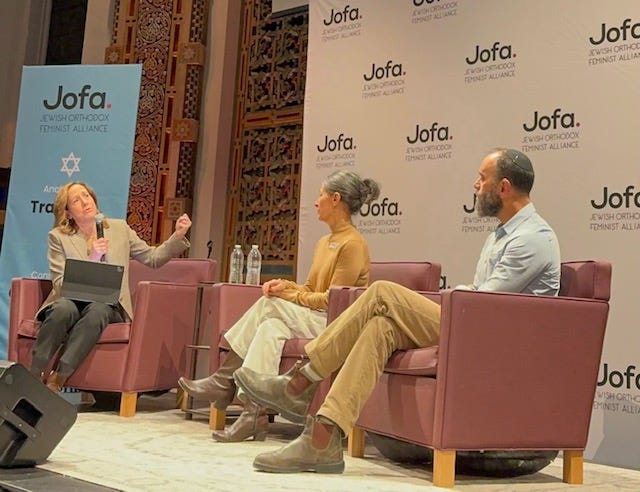
Opening their hearts: Rachel Goldberg-Polin and Jon Polin spoke to a recent JOFA conference about their experience as full-time advocates for Israel’s hostages. Moderator Abigail Pogrebin is at left.
We are living in a season of trauma that began in Israel on October 7 and has not gone away. On the contrary, as the war went on and Israel became an international pariah, expressions of antisemitism have increased around the world, from university campuses in the U.S., to violent attacks against Jews in Europe to the murder of innocent men, women and children celebrating Chanukah on a lovely beach in Australia.
One of the great frustrations for supporters of Israel is trying to change the minds of Hamas supporters in this country who embrace liberal values even as they defend a terrorist group dedicated to killing Jews and destroying the Jewish state. The most telling example I’ve heard comes from Jon Polin, husband of Rachel Goldberg-Polin and father of Hersh, a”h, probably the most well-known of the hostages abducted to Gaza on October 7.
Jon shared the story with journalist Abigail Pogrebin, who moderated a poignant conversation with Rachel and Jon at the recent JOFA (Jewish Orthodox Feminist Alliance) conference in New York. He told the large, spellbound audience that during a rare few days of solitude last summer, he and Rachel visited a close friend in a small town in Oregon. One morning they went to a local coffee shop and noticed that the barista was wearing a “from the river to sea” button. Rachel cautioned Jon not to bother getting into a conversation with the young man. Jon didn’t, but their host did engage the barista, leading to an argument.
After a few moments, Rachel walked over, put her hand out to the barista, asked him his name – Jake – and showed him a picture on her phone of Hersh. She explained, as she held Jake’s hand, that Hersh was her 23-year-old son, an advocate for peace and co-existence, who was one of six Israelis murdered by Hamas in a tunnel after being starved and tortured for almost 10 months.
Jake’s reaction was immediate. “Well, you guys are committing genocide,” he said angrily.
So much for compassion.
“He could have first said ‘I’m sorry for your loss’,” Jon noted sadly. He said he came to the conclusion that even in a situation with two people in dialogue, holding hands, “it’s so hard to connect on a human level.” It was a powerful moment for him, he acknowledged, a sobering reminder of the difficulty in “convincing anyone of anything” during these fraught times.
The lesson Jon took away from the encounter, he said, was: “just model who you want to be.” A simple statement with profound meaning.
Seeing Rachel and Jon up close, I felt like I knew this widely admired couple personally. I’m sure the audience felt the same way. So many of us have followed their courageous journey as they’ve traveled the world for more than two years, bearing their grief with dignity. Together, they not only advocated tirelessly for all of the hostages but did so with a soft-spoken but fierce display of faith, hope and humanity. That is the kind of modeling Jon was encouraging and that is all too rare at a time when empathy too often is seen as weakness.
As American-Israelis, Jon and Rachel exemplify behavior rooted in American freedom and democracy as well as Judaism’s emphasis on the value of every life, created in the image of God. In a world that seems to be tumbling out of control, with normative societal standards of public discourse, political debate, consensus on facts and respect for those with different views no longer in place, they challenge us to become our better selves.
Along the way, in navigating a deeply divided political climate they have tried to avoid diplomatic pitfalls, speaking out in ways that “widen the circle,” as Rachel put it, and expressing empathy for all who are suffering. “If you only cry for one side’s babies you lose your humanity,” she told the JOFA audience.
Pogrebin, the most sought-after moderator in Jewish life these days, conducted the conversation with great sensitivity. She created a comfort level where Jon and Rachel could be themselves, with flashes of humor, in addition to describing the anguish of their full-time advocacy. Though Rachel is usually in the spotlight in their travels, Jon was a full partner in the discussion.
Rachel spoke with eloquence and displayed her open, direct style in describing her most personal beliefs and fears. “It’s ok to be scared” about speaking out at times, “but don’t let it stop you,” she advised. In her role as a teacher, Rachel said she used to be nervous at times. But “October 7 scared the fear out of me,” she observed. “Even now it’s gone.” She attributes her strength to the comfort she draws from her religious faith. “Thank God I believe in God,” she said, “it’s everything to me.”
Like so many others, I have heard Jon and Rachel on numerous podcasts, read of their meetings with the pope, presidents, UN delegates and Jewish communities around the country. Perhaps most dramatic was the impact they had on the 20,000 delegates who gave the couple a standing ovation, chanting “bring them home,” when they took the podium at the Democratic National Convention in Chicago on August 21, 2024, with millions watching on television.
Rachel recalled during the JOFA interview that she and Jon had been sequestered for three days in a Chicago hotel prior to their appearance at the convention and had been warned to “prepare for boos and hate.” She said she was overwhelmed by the warm response, especially when she saw a woman in the audience who was wearing a kefiya and crying. “I put my head down on the podium,” she said. “I didn’t know how to receive such empathy. I cried.”
She told the world that summer night that she and Jon have been living “on another planet” since October 7, a world of “anguish and misery.” Jon emphasized that their struggle to free the hostages was “not a political issue, it’s a humanitarian issue.” He pointed out that “there is a surplus of agony on all sides of the tragic conflict in the Middle East. In a competition of pain,” he said, “there are no winners.”
Nine days later, their son, Hersh, and five other young hostages were murdered in a Gaza tunnel.
But Jon and Rachel’s tireless effort to speak out on behalf of the remaining hostages did not falter after learning the tragic news of Hersh’s death. They continued to speak out and still do so, though Jon acknowledged, “we’re still figuring out what’s next for us.” He noted that during “such a hard time” for world Jewry, “we try to speak prouder and louder of who we are,” deeply aware of “the link in this long chain” of Jewish history.
In reflecting on her advocacy, Rachel cited the Purim story of how Queen Esther was asked by Mordechai to risk her life to speak out and save the Jews of Persia. “If you keep silent at a time like this, relief and deliverance will come to the Jews from some other place while you … will perish,” Mordechai warned her. “And who knows whether it was for just such a time as this that you became queen.”
Taking that lesson to heart, Rachel said, “I want to carry this weight more gracefully,” adding that she and Jon “will carry this tremendous weight until we are in the ground next to Hersh, on either side of him.”
Her words hung heavy in the air, no doubt prompting each of us in the audience to ask ourselves how best we can respond to just such a time as this.
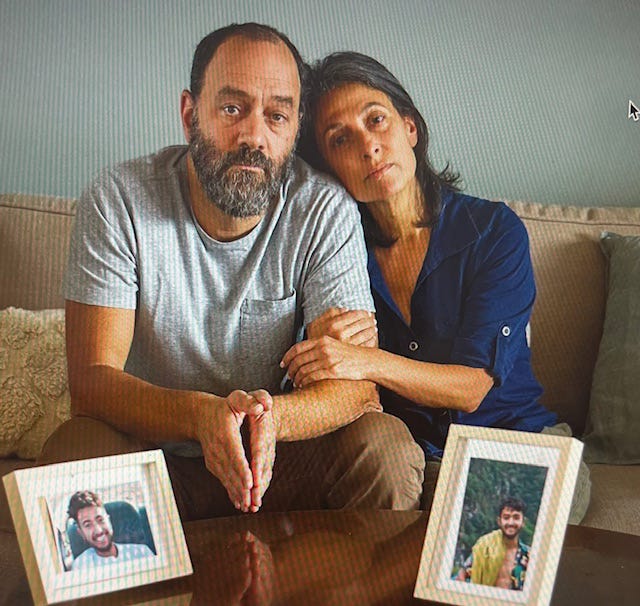
United in anguish and faith: Jon Polin and Rachel Goldberg-Polin, with photos of their son, Hersh, soon after October 7.
Note: Elliot Cosgrove, the rabbi of Park Avenue Synagogue and a leading voice in American Jewish life, published a poignant and timely book in 2024. It sought to place the tragedy of October 7 in the context of Jewish history, exploring how Jewish faith can apply in modern times. He chose the title “For Such A Time As This: On Being Jewish Today,” noting that “Mordechai’s words to Esther are a reminder of the role of Jewish agency in an out-of-control world filled with pain.”
Gary, this was beautifully written. A good friend of Scott's from college is Hersh's cousin, and grew up with the Polin's. They are exceptional people, and have been so strong. I have followed them and am overwhelmed with their ability to move forward, and change lives. Thank you for giving them your gift of this article.
I was fortunate to hear them speak last month. "Just model who you want to be," will stay with me. To be able for them to carry on and retain their humanity make them the model of what we all can be - if only.