
‘While Israel Slept’: A Reckoning
Yaakov Katz, an Israeli journalist and co-author of a new book detailing Israel’s greatest military failure, explains what went wrong on October 7 – and how to prevent another tragedy.

A call for pre-emptive mililtary action as ‘the new pillar of Israeli defense.’
While visiting Israel for Sukkot two years ago, I made sure to buy a copy of The Jerusalem Post’s special weekend edition on Friday, October 6. It marked the 50th anniversary of the outbreak of the Yom Kippur War, and several articles recalled that dark time when a surprise invasion from Egypt and Syria on the holiest day of the Jewish year brought Israel to the brink of destruction.
What struck me most as I read the paper that evening was an analysis of why Israel was so unprepared for the massive attack. With the wisdom of hindsight, the piece noted that there was simply a monumental failure of imagination within the government, the army and the intelligence units. There had been a strong consensus among Israel’s leaders that Egypt, soundly defeated six years earlier in the Six-Day War, was not prepared for or capable of a major attack on Israel. That belief was in large part based on a chain of fortifications – known as the Bar Lev Line – built by Israel along the eastern bank of the Suez Canal after the 1967 war, and considered to be invincible. Even though Israeli spotters saw and reported a dramatic increase of Egyptian soldiers on the other side of the canal in the days before the invasion, the response from IDF higher-ups was that the Egyptians must be anticipating an attack by Israel.
Such misguided thinking resulted in Egypt attacking from the south and Syria from the north, with Israel caught off-guard. For a few days Israel seemed headed for a disastrous defeat. In the end, the IDF not only prevailed but conquered additional territory. Still, 2,600 Israeli soldiers were killed during almost three weeks of fighting, and Israelis were traumatized by the realization that the Jewish state had barely survived.
Little did I know, on reading the article, that the next morning Israel would pay a horrific price for a failure of imagination of far greater magnitude. And like the mistakes made 50 years ago, the dismissed or misread signals leading up to Hamas’s slaughter of innocent Israelis – men, women and children – were based on the belief that the enemy was incapable of a successful attack and that Israel was secure.
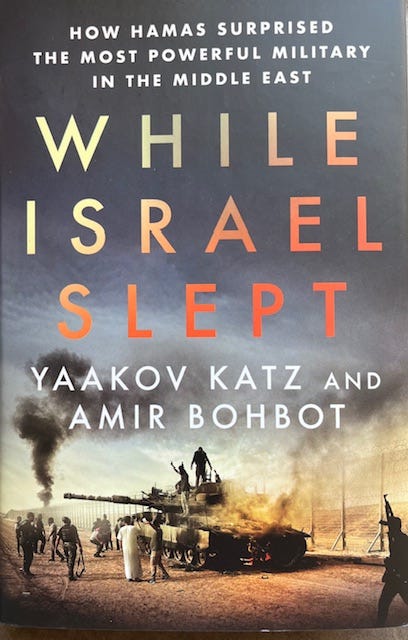
Yaakov Katz and Amir Bohbot, two Israeli journalists with years of experience in reporting on military affairs, have written a vital, painfully detailed account of how Hamas, Israel’s weakest enemy in the region, managed to plan, launch and carry out the worst single attack on Israel in the nation’s history on October 7, 2023.
It is heartbreaking to read the 64-page opening chapter of “While Israel Slept: How Hamas Surprised The Most Powerful Military In The Middle East,” offering numerous examples of how top Israeli officials misread the last-minute signs leading up to the surprise attack. Most poignant is the introduction, describing how the IDF’s young female soldiers tasked with monitoring the Gaza border 24/7 on their computers had issued warnings to their superiors of suspicious behavior by Hamas for several weeks, in vain. The information was dismissed by Military Intelligence officials, who expressed annoyance with the reports.
On October 7, when the IDF’s Nahal Oz base was overrun and set on fire by Hamas terrorists, 16 of the young women – ages 19 and 20 – were killed and burned, along with more than 50 soldiers. The seven young women who survived were taken hostage.
There are many elements of Israeli leadership to blame for the tragedy of October 7, from the IDF to military intelligence to the government and its highest officials. Katz and Bohbot, through their research and interviews with highly placed sources in each of these arenas, have, in effect, provided a blueprint for the inevitable state investigation on October 7 that Prime Minister Netanyahu has until now refused to initiate.
“In working on this book, Amir and I came to recognize that Israel can overcome external threats,” Katz told me during a visit to the U.S. last week. “But Israelis have to realize that unity from within is our greatest defense,” and that goal remains elusive.
A 46-year-old native of Chicago who made aliyah with his family when he was 14, Katz has been in the U.S. several times to promote the book since its publication in September. (His co-author, Bohbot, currently holds the chair of security and intelligence at Bar-Ilan University.)

Yaakov Katz: ‘Israelis have to realize that unity from within’ is essential.
I interviewed Katz at Temple Beth-El of Great Neck the evening of October 22 at a program sponsored by the synagogue and the Great Neck-based Gold Coast Arts Center. He is a polished and effective communicator of the written and spoken word, a columnist for The Jerusalem Post, where he served as editor for seven years, and host of a weekly podcast on Israel affairs for the Jewish Policy Planning Institute (JPPI), a non-profit Jerusalem-based think tank, where he is a fellow. (I serve on the JPPI international board of governors.)
Katz told the audience of about 200 people that while Israelis want to be left alone and live in peace, “we deceived ourselves when Hamas told us ‘we’re coming to kill you’ and we didn’t believe it. How could this happen?”
During the program, we discussed some of the highlights of “While Israel Slept,” which deals not only with military, diplomatic and political issues but also the marvels and pitfalls of human psychology. The same Israeli leaders who came up with brilliant tactics to virtually wipe out Hezbollah through pager explosives, deeply set back Iran’s nuclear weapons plan, and eliminate leaders of Hezbollah and Iran’s army and intelligence sectors through pinpoint assassinations were baffled by Hamas and its strategies.
In large part, Katz said, these events underscored the IDF’s deep emphasis on the threats to Israel posed by Hezbollah and Iran. In contrast, relatively little serious attention was given to Hamas, a smaller terror group believed to be more interested of late in reducing its aggression against Israel in return for relative quiet. That’s why for years the Netanyahu government approved of Qatar providing $30 million a month to Hamas as a means of maintaining calm on the border and to drive a wedge between Hamas in Gaza and the Palestinian Authority in the West Bank to reduce the threat of a Palestinian state.
As a result, while Israel had numerous operatives in Lebanon and Iran providing detailed information on secret plans there, not one undercover agent was placed in Gaza. That lack of inside information proved to be tragic. Israel spent many millions of dollars on high tech sensors and spy technology to monitor the Gaza border – a modern-day Bar Lev line. But it was crossed on October 7 when thousands of Hamas fighters simply cut and overran the fences.
One chapter, “The Tunnel Blindness,” details how Israel made extensive efforts over the years to prevent Hamas tunnels from leading into Israel. That is how IDF soldier Gilad Shalit was captured in a cross-border raid in 2006 and held by Hamas for five years. But the IDF did not take into account that the primary use of the tunnels was as a Hamas operational base, allowing terrorists to return from their October 7 attack and hide hostages there.
Not one terrorist that day entered Israel from a tunnel.
Most practical and helpful is the last chapter of the book, offering recommendations for bolstering Israel’s security. It includes calls for:
. more cooperation, review and debate among the various IDF and intelligence units in making decisions;
. expanding the government’s decision-making group, noting that Netanyahu relied mostly on his most trusted aid, Ron Dermer, and Defense Minister Yoav Gallant, who he fired twice;
. less reliance on U.S. militarily since all of of the IDF’s planes and tanks are American-made, including spare parts;
. a serious effort to return to bipartisan support from Washington, where the damage among Democrats has been felt since Netanyahu spoke out in Congress in 2015 against President Obama’s position on Iran’s nuclear program. The prime minister’s decision to tie his fate to Donald Trump has succeeded for now, but it is temporary;
. improving diplomatic diplomacy because the lack of qualified professionals to strengthen Israel’s world image during the war has been disastrous;
. preparing an exit strategy before taking military action. Failure to define “total victory” or provide a “day after” plan prolonged the war and cost countless lives.
Perhaps most important was a call for Israel to focus on pre-emptive action as “the new pillar of defense.” Until now, the IDF hesitated to strike first against Hamas rockets and other terror activities, fearing being stuck in a ground war in Gaza.
“We have to live with the sword in our hand for many years to come,” Katz told the audience in Great Neck.
He closed by returning to his original call for Jewish unity, noting that his time in America in recent days made him realize that “the war we’re fighting in Gaza poses a threat that connects it to the anti-Semitism here in America,” and calls for greater solidarity between Israeli and diaspora Jews. “In the Mideast,” he said, Israel’s enemies “want to kill Jews. Here in the U.S., “on a metaphysical level, there’s an effort to destroy Jewish pride” and make Jews feel afraid.
Katz said it’s important for Israelis to appreciate “how much American Jews have suffered” from the consequences of the war and to realize that many young Jews have turned away from Israel. The lesson for American Jews: to understand that Israeli society remains traumatized, with hardly a family untouched by the horror of the war, and “just starting a healing process.”
The lesson for Jews everywhere, Katz concluded, is that “we all need to stand together.”
So true, Neil. I am in the middle of reading "Hostage," very gripping, and waiting on my night table are "One Day In October" and "10/7: 100 Human Stories"... so sad. Thanks as always for you comments and kind words.(To avoid overload, Must Read: "The Last Manager," bio of Earl Weaver, terrific.)
Toda! Thanks! Oct 7 changed history. Heinous.